The dot in overs is a separator
Cricket notation often looks familiar enough to invite the wrong calculation. A scoreboard reading 7.4 overs appears to be a decimal, yet in ordinary six-ball-over notation it means seven completed overs and four legal deliveries. Converting that display correctly is a small skill with a large practical benefit. It keeps run rates, remaining-ball counts and bowling comparisons consistent. This guide uses fictional figures and simple arithmetic so that every step can be checked without needing a particular player's record.
Start by naming the unit. Runs, balls, overs and wickets are not interchangeable numbers in one long string. A scoreboard places them close together for convenience, but a calculation must keep them separate. If you copy 7.4 into a spreadsheet as a decimal, the software will follow the value you entered rather than infer cricket's display convention. The error begins with the representation, before any formula has been evaluated.
Convert the display into balls
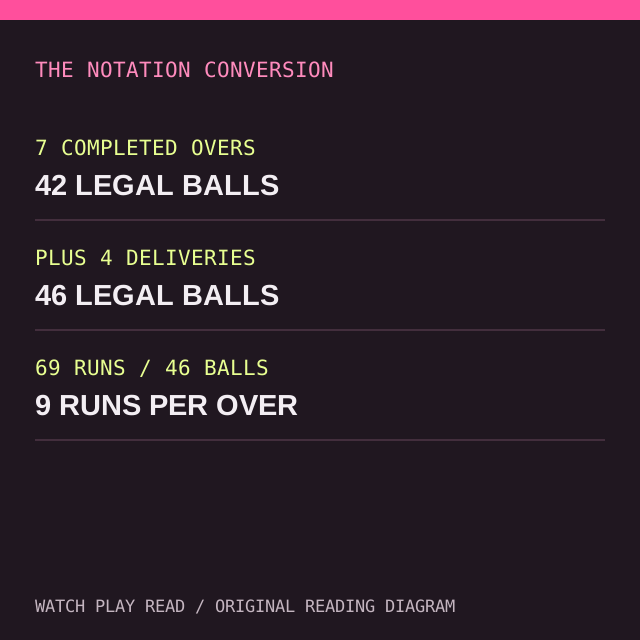
For an ordinary six-ball over, multiply completed overs by six and add the legal deliveries after the separator. Seven completed overs contain 42 legal balls. Add four and the total becomes 46. Write the conversion explicitly: 7.4 displayed overs corresponds to 46 legal balls. Do not write that 7.4 equals 46 without the units, because the sentence would hide the very distinction you are trying to preserve.
This exercise concerns legal deliveries, not every delivery attempt or every event on a commentary feed. A live account may show additional events that do not advance the legal-ball count in the same way. The applicable Laws and competition conditions establish those details. Consult the MCC Laws resource for the formal framework. When working from a published scorecard, use its official overs notation instead of counting an unverified list of screen events.
Calculate the run rate
Suppose a fictional team has scored 69 runs after 7.4 overs. The denominator is 46 legal balls, equivalent to 46 divided by six overs. The run rate is therefore 69 divided by 46 and multiplied by six, giving nine runs per over. Using 7.4 as a decimal denominator would produce about 9.32, a different and incorrect answer for this representation. Both calculations may look plausible if the units are omitted.
Notice why multiplying by six appears in the correct calculation. Runs divided by balls gives runs per ball. Multiplying by six expresses that rate per six-ball over. It does not add six runs or alter the innings total. A good note retains the inputs, operation and output unit. When you revisit the arithmetic later, you should be able to reconstruct the result without guessing what each number represented.
Work backwards carefully
To express 46 legal balls in overs notation, divide by six and keep the whole quotient and remainder separate. The quotient is seven and the remainder is four, so the display is 7.4. The remainder is a ball count, not tenths of an over. Under this convention, a remainder of six completes another over rather than producing a normal display ending in .6. Understanding that boundary prevents a common counting mistake.
Try 59 legal balls. Nine groups of six account for 54 balls, leaving five, so the display is 9.5. The next legal delivery completes ten overs. You have crossed from 9.5 to 10.0 in the notation while adding only one legal ball. A decimal-number interpretation cannot express that relationship correctly. This is why a ball count is often the safest internal value for an arithmetic exercise or a small personal data table.
Count what remains
In an invented full-length 20-over innings using six-ball overs, the scheduled allowance is 120 legal balls. After 7.4 overs, 46 have been completed, leaving 74 scheduled legal balls. That arithmetic assumes the allowance remains unchanged and the innings continues. A revised match, an earlier end to the innings or competition-specific circumstances can change the context. State the assumption alongside the calculation instead of presenting 74 as a universal match forecast.
Do not subtract displayed notation as though it were ordinary decimals. Twenty minus 7.4 gives 12.6 numerically, but that is not the normal overs display for the remaining 74 legal balls. Convert the remainder back: 12 groups of six and two additional balls make 12.2 overs in notation. The ICC format overview explains broad format lengths; use actual match conditions to establish the allowance for a real innings.
Preserve the original and the calculation
If you make a reading sheet, keep two columns: original display and converted legal balls. Add separate columns for runs and the calculated rate. This allows another reader to check the conversion before checking the arithmetic. It also protects you when a pasted value loses its trailing zero. A display of 10.0 should still mean ten completed overs, even if a general-purpose tool renders the cell as 10.
Use a text field for the original display when necessary. Then derive a numeric ball count in a separate, clearly labelled field. Never overwrite your only copy of the source notation during cleaning. If a value cannot be parsed under your stated convention, mark it for review. Silently treating an unexpected value as zero can distort a whole comparison while leaving the final chart looking perfectly tidy.
## Test the conversion at a boundary
Boundary cases expose notation mistakes quickly. Check that five legal balls display as 0.5, six as 1.0 and seven as 1.1 under the six-ball-over convention. Then check that 35, 36 and 37 display as 5.5, 6.0 and 6.1. These are not current match observations. They are small arithmetic checks designed to reveal a representation error before it spreads into a larger comparison. If your conversion fails one of them, correct the conversion before calculating a rate.
Keep rounding until the final presentation step. A rate derived from an early rounded over-equivalent can drift from the rate calculated directly from legal balls. The exact ball count is an integer, so there is no need to round it away. Compute from that count, state the reporting precision and preserve the full inputs. More displayed decimals do not repair uncertain data, but avoiding unnecessary intermediate rounding keeps a correct small calculation from becoming needlessly inaccurate.
A useful final check is to reverse the conversion and recover the original display. If converting your calculated ball count back into overs does not reproduce the source notation, stop and inspect the input. This small round trip catches many mistakes before they become a misleading rate in a written comparison.
Distinguish similar rates
Batting strike rate and team run rate use different normalisations. A batter scoring 30 runs from 20 balls has a strike rate of 150 runs per hundred balls. A team scoring the same 30 runs from 20 legal balls has a run rate of nine runs per six-ball over. The inputs look similar, but the reported units differ. Neither number should appear in prose without a label when confusion is possible.
Our scorecard reading guide places those figures back inside an innings. The Watch Play Read issue connects the arithmetic to viewing and interpretation. Cricketin is a sponsored reference for another explanatory route. A correct conversion will not tell you who wins a match, but it will ensure that the question you ask begins with a coherent denominator. That is the point of learning the notation rather than merely memorising the appearance of a scoreboard.