Attention is a skill you can practise
You do not need to understand every cricket term before enjoying a match. You do need a way to direct your attention without becoming overwhelmed. A score graphic, commentary, crowd noise and rapid replays compete for the same few seconds. This guide suggests a personal watching notebook built around three activities: notice, ask and return. It is a reading exercise, not a claim about coaching expertise or a prescribed way to support a team. The examples are fictional prompts that you can adapt.
Begin with the reason you chose to watch. Perhaps you enjoy a particular movement, the pace of a short contest or the patience of a longer passage. That preference is useful information about your own attention. It does not need to become a declaration that every other format is inferior. A personal response can be specific without pretending to settle an argument about the whole sport. Give yourself permission to be interested before trying to sound authoritative.
Choose one question for the passage
A beginner often tries to watch everything at once. Instead, choose one manageable question for a short passage. You might follow how the score changes between completed overs or notice where a fielder stands before consecutive deliveries. The question should describe something observable. Watch for confidence is too vague to check; note whether the same fielding position changes between two shots is more concrete. You can then compare your notes with what the screen actually showed.
Keep the viewing interval small enough to remember. A few overs may be more useful than an entire innings if you are learning to distinguish deliveries and replays. The end point is not a test of endurance. It is a moment to review what your chosen question helped you notice. If the broadcast never supplied the necessary camera angle, record that limitation rather than invent an answer. Sometimes a question cannot be answered from the available coverage.
Separate observation from interpretation
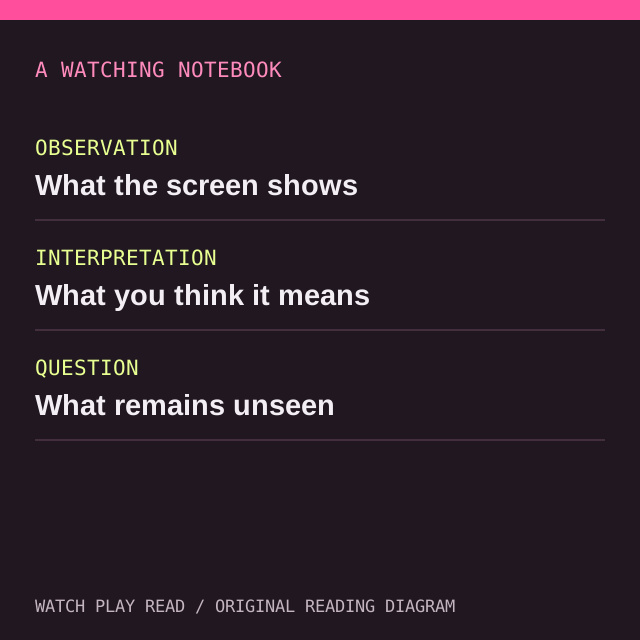
Divide a page into two columns. On the left, record what you saw or what a labelled scorecard states. On the right, put your interpretation. A fielder moved closer is an observation if the images establish the change. The captain wanted to intimidate the batter is a claim about intent, and needs a different kind of evidence. Keeping the columns apart makes the second claim easier to revisit without losing the first.
Add a third mark for questions. Perhaps the screen cuts away just before the change, or commentary suggests a reason that the images cannot confirm. A question mark is a useful outcome of watching. It points towards a source you might seek later: continuous footage, a match report, or a direct explanation from someone involved. You are building an honest record of attention, not a script in which every detail must have an immediate answer.
Use vocabulary as a tool
Collect unfamiliar words in context. Write the term, the sentence in which you heard it and what you think it refers to. Then check a reliable source. The MCC introduction to the Laws of Cricket is a starting point for formal rules. A commentary expression may be informal rather than a defined term. Do not assume that every phrase has the same status as a Law simply because the speaker uses it fluently.
Learn a small number of terms well before collecting a very long glossary. If you understand what the scoreboard's overs notation represents, you can ask clearer questions about time and rate. If you can distinguish an observed event from a replay, you can take a better viewing note. Vocabulary should reduce confusion. When a word merely decorates a sentence without helping you describe anything more precisely, leave it out until you need it.
Revisit one assumption
After the passage, choose one interpretation from the right-hand column and ask what would weaken it. If you thought a batter became more aggressive, did the number of scoring attempts change, or did the editor simply show more boundaries? If you thought a partnership felt slow, which interval and comparison produced that impression? These questions do not invalidate your experience. They connect the experience to a definition that another person could understand.
Our claim-checking guide develops this habit into a small evidence exercise. For a personal notebook, the process can remain simple. Circle one assumption, add the missing context and rewrite the sentence. I felt that the passage dragged is a valid reaction. The team was objectively slow requires a defined comparison. Both statements can coexist when you keep their purposes clear.
Make room for the unremarkable
Not every useful cricket observation is a spectacular event. A quiet passage can show repetition, changing field placements or the relationship between a score and the time remaining. A broadcast may move quickly past those details because they are difficult to package into a short montage. Choose one ordinary delivery and describe its place in the sequence. You may discover that understanding the surrounding passage makes the eventual highlight more satisfying.
Avoid turning this into a demand that every moment must conceal a secret tactic. Sometimes a quiet passage remains quiet in your notes. The notebook is allowed to contain an incomplete description. Its value lies in preserving what you could establish, not in producing a profound lesson from every ball. Ordinary attention becomes more reliable when it does not have to manufacture an impressive explanation for each observation.
## Let the notebook contain enjoyment
Leave a place for a moment you simply liked. Describe the sound, the anticipation or the camera's view without forcing a statistical defence of your reaction. This protects a useful distinction: an observation exercise can make your explanations better while remaining part of a hobby. You do not owe every enjoyable passage an academic argument. A note saying that a sequence held your attention is honest when it describes your experience rather than a universal measure of its quality.
Once a few sessions have passed, look back for recurring questions. Perhaps you repeatedly lose track of the innings after an interruption, or confuse a replay with the next delivery. Choose one of those specific difficulties for the next watch. The notebook becomes practical when it reveals where your attention needs support. Avoid using it as a scorecard of your own expertise. Its purpose is to help you see a little more clearly each time, including the moments that remain uncertain.
Keep a sustainable reading rhythm
At the end of a viewing session, write a short summary rather than transcribing everything. One observation, one clarified term and one unanswered question are enough. The next time you watch, return to that question and see whether the new passage provides a useful comparison. This makes learning cumulative without turning a hobby into a performance of expertise. You can stop the exercise when it interferes with enjoying the match.
The Watch Play Read homepage groups guides by watching, numbers and interpretation so that you can follow the question that interests you. Cricketin is a sponsored partner reading reference, not a record of your match or a substitute for a governing-body source. Your own notebook can remain personal and provisional. The aim is to notice more clearly, explain your reaction more honestly and leave yourself a reason to look again.