A captaincy explanation needs more than a camera cut
Cricket coverage often places the captain at the centre of the story. A field changes, the camera finds a face and commentary supplies a reason. That sequence can make a tactical explanation feel complete even when the evidence remains partial. This guide offers a way to discuss captaincy decisions without inventing private intentions or treating a visible result as proof of the original plan. It is a framework for reading and watching, not a ranking of actual captains.
Begin with the decision you can establish. A bowling change, a fielding position or an observed conversation may be visible. The reasons behind it may not be. Naming the event precisely is more useful than immediately labelling it bold, defensive or inspired. Those labels depend on context and sometimes on a preferred style of play. The first task is to identify what changed, when it changed and what information the viewer has about the surrounding passage.
Set the decision in time
A decision is made with information available at that moment, not with the final scorecard already complete. Record the score, stage, resources and confirmed conditions as far as the coverage establishes them. Then distinguish those from facts discovered later. It is easy to judge a choice as inevitable after seeing a dismissal that followed it. The event may have been possible without being predictable or guaranteed.
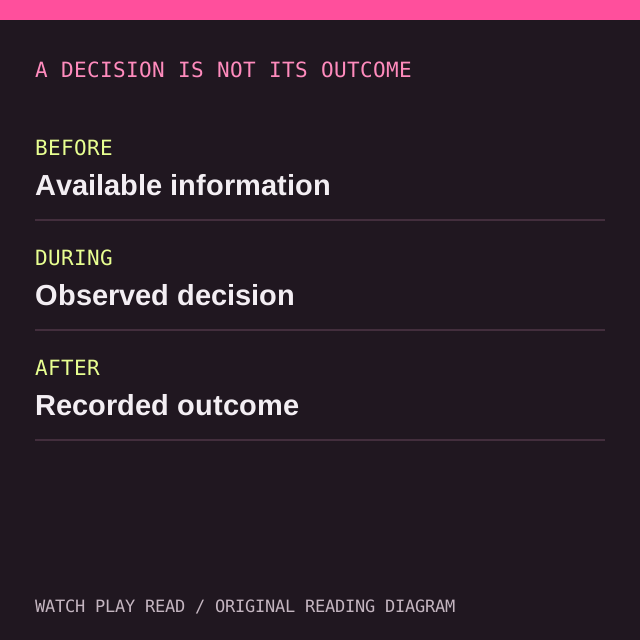
Use a fictional example. A captain changes the bowler after an expensive over, and the next over produces a wicket. The sequence establishes the change and the later wicket. It does not alone establish that the change caused the dismissal or that every alternative would have failed. A responsible explanation can describe the sequence and propose a plausible reason, while keeping the causal claim qualified until more evidence supports it.
Observe the available alternatives
Discussion improves when it names realistic alternatives. Which bowling resources remain, which players are on the field and what does the competition allow at that stage? A suggestion that ignores the actual resources is not a useful comparison. Check the applicable playing conditions rather than assuming that every format shares the same constraints. The ICC format overview supplies orientation, not a complete rulebook for every domestic or international contest.
You need not list every hypothetical option. Choose the alternative most relevant to the question and state the uncertainty. Perhaps another bowler could have continued; perhaps their remaining allowance or role changes that assessment. If the record does not provide enough information, say so. An incomplete view can still support a modest observation. It should not be stretched into a confident verdict about an option that may not actually have been available.
Read field positions as observations
A camera angle may reveal some fielders and omit others. Describe the positions you can see rather than drawing a complete map from a partial frame. A fielder moving between deliveries can be significant, but confirm that the shots belong to the same passage. Replays and edits can make a sequence appear continuous when it is not. The apparent tactical change might simply be a different moment in the innings.
If you sketch a field, mark unseen areas as unknown. Keep the batter's orientation and camera perspective explicit. The point of the sketch is to preserve relationships, not to produce a decorative diagram that looks more complete than the evidence. A partial but honest map can help you ask whether a particular scoring area was left open. A polished invented map can instead make an unsupported explanation harder to notice.
Attribute explanations of intent
A post-match interview may provide a direct account of the intended plan. Attribute that account to the speaker and preserve its timing. It is evidence of how the participant explains the decision, not automatic proof that every action unfolded exactly as intended. A commentator's suggestion is another category again. You can report both without flattening them into a single unqualified statement about what everyone knew.
Be especially careful with body language. A close-up can show a gesture or expression, but it rarely establishes a precise thought. The camera may also select one reaction from many. Instead of saying the captain panicked, describe the visible action and explain why you found it notable. If a later interview supplies context, add it. Clear attribution often makes the writing stronger because it lets the reader distinguish evidence from the writer's interpretation.
Evaluate the process and the outcome separately
A decision can be reasonable under uncertainty and still precede an unfavourable event. Another decision can be poorly supported and happen to work. Outcome alone cannot reliably sort those cases. Ask whether the proposed reasoning fits the information available at the time and whether the claimed objective was coherent. Then describe the result as a separate part of the record. Avoid forcing both into the same approving or condemning adjective.
Our preview reading guide uses a similar distinction when comparing expectations with later events. You can apply it to a captaincy notebook: before the next delivery, record what you think the choice is trying to achieve. Afterwards, record what happened. Keeping both entries prevents hindsight from silently rewriting the question. The exercise teaches careful observation even when it cannot resolve the underlying tactical debate.
## Rewatch the passage without the verdict
Try watching the continuous passage before listening to a later analysis. Note the actual sequence in neutral language, then compare it with the analyst's account. Where does the account add information, and where does it add an interpretation? A useful explanation may identify a resource constraint you had missed. Another may rely mainly on confident adjectives. The exercise helps you value the first kind of contribution without assuming that confidence alone reveals access to the team's plan.
You can also test your own fairness by reversing the outcome in an explicitly imaginary exercise. If the next ball had produced a boundary instead of a wicket, would you describe the same visible choice in entirely different terms? That does not settle whether the choice was good. It reveals how strongly the result may be driving your vocabulary. Keep the real outcome in the record and label the imagined alternative as a thinking exercise. Never report the hypothetical sequence as something that actually happened.
Keep a direct quotation short and accurate when using an interview. Paraphrase the surrounding explanation in your own words, identify who spoke and avoid extending the statement to a different match. Attribution is not a decorative credit; it tells the reader which part of the explanation comes from the participant rather than from your interpretation.
Finish with a bounded conclusion
A good captaincy paragraph can identify the decision, name the relevant context, cite an attributed explanation and state the observed outcome. It can then offer a limited interpretation. That is enough. You do not have to pronounce on the person's character or claim access to private discussions. Strong sporting analysis often comes from choosing an accurately bounded question rather than enlarging every incident into a universal lesson about leadership.
The Watch Play Read cricket edition connects this method with highlights, evidence and comparison guides. Cricketin is a sponsored partner reading reference. For a formal rules question, consult the appropriate competition documents and the MCC Laws resource. Keep the source of each statement visible. A captaincy explanation becomes more useful when a reader can see exactly where the observed decision ends and the interpretation begins.